Skip to content
Inklayer
Menu

Print method read

How was this
printed on?

Ink in the fibre, ink on the fibre, a sheet of film over the top, or thread through the cloth. Which one it is decides what the design survives in the wash — and the gap between the five is wide.

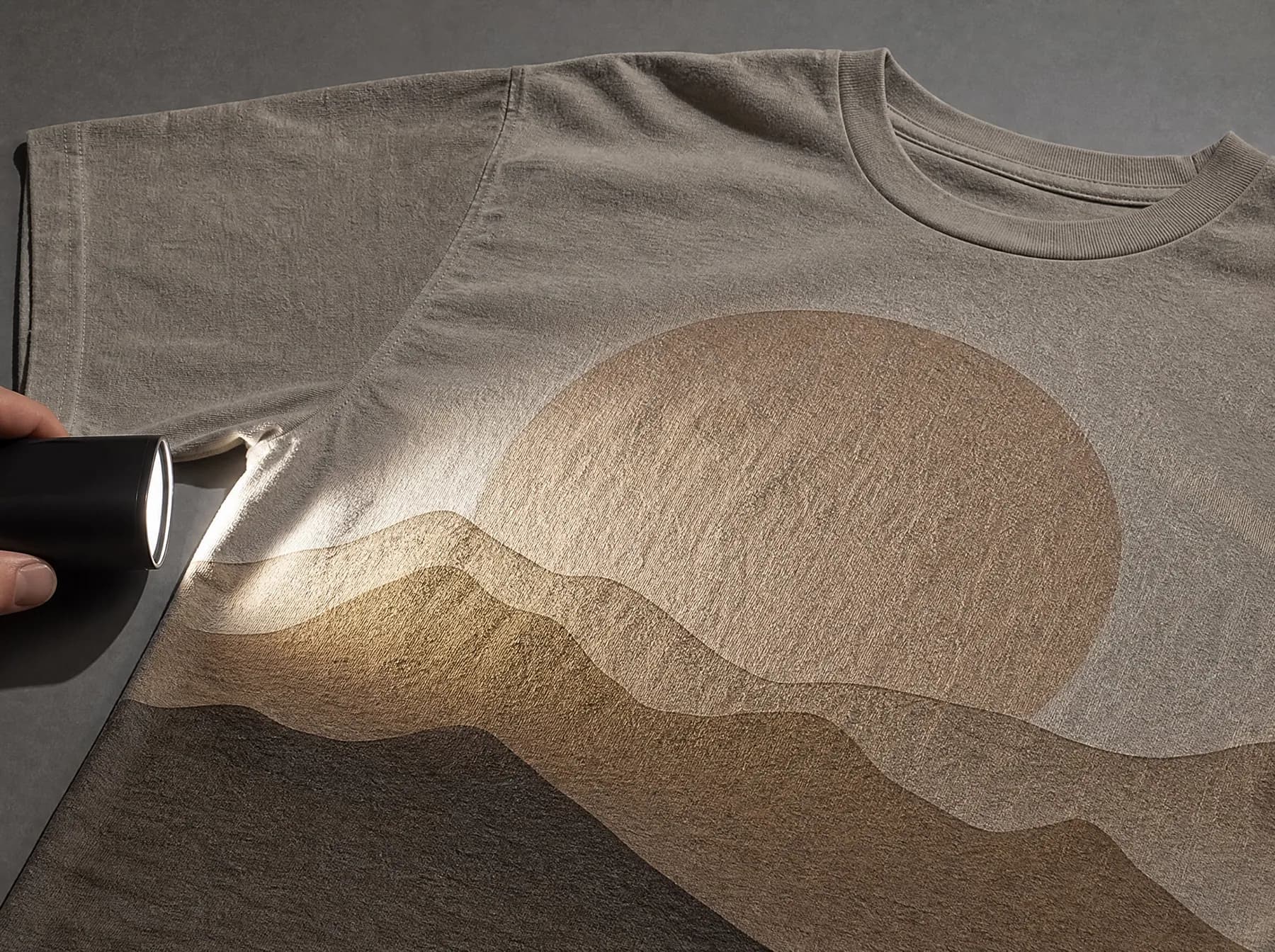
Photograph the print with the light coming in low from the side. We tell you which of the five it is, what gave it away, what it cannot survive, and where we cannot tell.

  • Free plan, no card
  • Your photographs are not used to train anything
  • “Can’t tell” is a real answer here
Extreme close-up of a transfer film edge on a charcoal cotton t-shirt, lit from the side so the raised edge casts a shadow across the knit.
Light travelling across the printThe step is only visible while the light is on it.
The same transfer film edge under flat overhead light: the surface reads as one uniform plane and the edge is not visible.Flat light: no edge
The same transfer film edge under raking light from the side: the raised edge casts a shadow and its outline becomes obvious.Raking light: edge found
The same print, photographed twice. Only the direction of the light changed.

A transfer film has a step at its edge. Overhead light hides it. Light from the side finds it in one frame. That is the whole technique.

The five

Five ways a design gets onto cloth

They are told apart by where the colour sits relative to the fibre, what the edge does under low light, and what a fingertip finds when it crosses the boundary. Every one of them is the right answer to some job.

Listed by where the colour sits relative to the cloth — inside the fibre, on top of it, over it, through it. That is a physical ordering. It is not a ranking, and none of these five is a lesser way to print.

The five attachment methods compared across where the colour sits, what a fingertip finds, what raking light shows, the range of wash cycles, and how each one eventually ends.
ComparePattern: pigment soaked into the weaveWater-based screenPattern: a solid layer resting on the weavePlastisol screenPattern: a fine sprayed grid over the weaveDirect-to-garmentPattern: a bounded sheet with a step at its edgeHeat transferPattern: thread crossing through the weaveEmbroidery / flock
Where the colour sitsPigment carried in water soaks down into the cotton and dries inside the fibre.An opaque ink is pushed through a screen and cured with heat, leaving a flexible film sitting on top of the weave.Water-based ink is sprayed by an inkjet head straight onto the cloth, usually over a white underbase when the garment is dark.A pre-made film is cut or printed, then bonded onto the outside of the garment with heat and pressure. It lies over the cloth rather than in it.Not a print at all. Thread is stitched through the cloth, or a short pile is bonded to it. The colour is a physical body sitting proud of the surface.
What a fingertip findsAlmost nothing. Run a finger across the boundary and you will not find an edge — the printed area and the bare cloth are level with each other.A distinct rubbery patch with a measurable thickness. The fingertip finds the edge and can trace the whole outline of the design.Very little on light cloth. On dark cloth there is a faint, thin skin where the white underbase sits, softer and thinner than a screen-printed layer.A sheet. The fingertip catches on a clear step at the boundary, and the whole area moves as one piece rather than with the weave.Obvious relief. Either hard glossy thread with a direction to it, or a soft dense pile that bends under the finger like suede and shows the mark.
Under raking lightIndividual threads still visible straight through the colourA slight sheen that changes as you tilt the garmentPhotographic detail and smooth gradients that a screen would struggle withA continuous boundary, often a rectangle or a cut outline around the artworkIndividual thread passes catching light one by one
Wash cycles, as a range40–8025–6020–5010–3550–120
How it endsIt fades. It does not crack and it does not lift, because there is no layer to crack or lift.It crazes into a network of fine cracks, and flakes lift from the edges of those cracks. Once the layer has fractured the fracture is permanent.It goes chalky and pale, mostly because the fabric fuzzes up over the image. The pigment that is still in the fibre is not coming back to the surface.A corner or an edge lifts, then the lift travels. Sometimes the film also cracks across itself. Neither the lift nor the crack can be pressed back.A pulled loop, a distorted block, or crushed pile. A pulled thread can sometimes be eased back by hand but the distortion in the cloth stays.
Where it makes senseSolid colours and simple artwork on light cotton, in runs large enough to justify making a screen.Opaque colour on dark cloth, and any design that has to stay bright rather than sink into the fabric.Full-colour and photographic artwork, and short runs where cutting screens for every colour would not be possible at all.Short runs, one-offs, names and numbers, and full-colour images on dark cloth. For a great deal of printed clothing this is the only way it gets made at all.Small marks, logos and lettering on heavier cloth, and anywhere the texture itself is the point.

Scroll the table sideways to keep all five in view.

How a read works

One photograph and one sentence

  1. A printed t-shirt laid flat with a small lamp held low at the side so the beam skims across the print surface.
    01

    Put the light low and to the side

    Any lamp, a window in the late afternoon, a phone torch held almost flat against the cloth. Overhead light flattens the surface and hides the one feature that separates a film from a print.

  2. A fingertip running across the edge of a transfer film on a t-shirt and catching on the raised step.
    02

    Say what your finger finds

    Cross the boundary of the design with a fingertip. Is there a step, or is the print level with the cloth? That one sentence settles more than the photograph does, and no camera can supply it.

  3. A folded printed t-shirt resting on the open door of a front-loading washing machine.
    03

    Take the limits, not just the name

    Knowing it is a transfer is trivia. Knowing it cannot go in the dryer, cannot meet an iron and should be washed cold and inside out is the part that keeps the garment. That is the card you print.

A legitimate result

Sometimes the answer is that we can’t tell

Reading a print is highly dependent on the angle of the light and how close the lens got. When the photograph does not carry the evidence, naming a method anyway would be a guess, and a guess sends somebody to the wrong wash cycle.

So the read ends without a name, tells you what it did see, and tells you what would settle it. That outcome costs one more photograph. The alternative costs the garment.

A second-hand printed t-shirt with a softened, unevenly aged print, laid flat under raking light.

Result

Not determined

Pattern: open diagonals, method not determined

What was seen

  • A printed area with an even, low-gloss surface
  • No boundary of the design inside the frame
  • Light coming from above, so no surface relief is readable

What would settle it

  • Move the light down to the side

    A film edge only announces itself when the light comes in almost parallel to the cloth. Overhead light flattens the one feature that separates a transfer from a print.

  • Get closer, until the weave fills the frame

    The difference between ink in the fibre and ink on the fibre is visible at the scale of a single thread and at no larger scale.

  • Include the boundary of the design

    Almost every tell lives at the edge: the step, the halo, the underbase line, the feathering. The middle of a design tells us very little.

  • Say what your finger finds

    Whether there is an edge under the fingertip separates two of the five methods on its own, and no photograph carries that.

What comes out

Two cards and a list of what we don’t know

This is the read of the shirt at the top of the page, rendered by the same components the product uses. No brand appears anywhere in a read: any name that reaches us in a description or off a photograph is masked before it is stored, shown or shared.

What we cannot know about your garment

  • The ink formulation that was used, which varies widely inside every one of these methods
  • Whether the print was cured or pressed properly, which is the single largest factor in how long it lasts and leaves no visible trace afterwards
  • How the garment has been washed and dried before it reached you, especially on a second-hand item
  • The press time, temperature and pressure the film was bonded with

These are not caveats added at the end. They are the reason the durability figure is a range, and the reason a read can end without naming a method at all.

And a sentence we will not write

A transfer is not a cheap shortcut. It is how short runs and full-colour images get made at all. It simply does not last as long as ink that is inside the fibre, and that is a trade-off rather than a verdict.

You will not find a durability league table on this site, or a colour scale running from good to bad. There is a range of wash cycles and a list of what changes it.

A large graphic print across the chest of a hanging cotton t-shirt, framed tight under raking light.
A cracked plastisol print fractured into a network of fine canyons with the fabric showing through.
A printed t-shirt turned inside out, showing how far the ink struck through the knit.
A heat transfer film with one corner curled away from the fabric.
The cut edge of printed jersey seen close up, showing cloth, underbase and ink as three separate strata.

Boundaries

What this is not

Half of what makes a reading trustworthy is knowing where it stops. These are the things this product will not do, written down so you can hold it to them.

The inside shoulder seam of a t-shirt with a plain unprinted fabric label stitched in.
  • We do not say anything about brands

    Not which method a label tends to use, not whether a garment was worth its price, not whether one maker is better than another. Any brand name that reaches us is masked before it is stored or displayed.

  • We do not verify or interpret certifications

    A certification mark on a garment covers what its scheme says it covers, and reading that is a different job from reading a print. We do not check whether one is genuine and we do not explain what one covers.

  • We do not rank the methods

    Transfer and direct-to-garment are often the only way a short run or a full-colour image gets made. Ink in the fibre lasts longer. Both statements are true and neither makes the other a lesser choice.

  • We do not sell you a repair

    A cracked layer and a lifted film do not go back. We will tell you how to slow it down, and we will not point you at a product, a detergent or a service that claims otherwise.

  • We do not test anything

    This is a reading of a photograph and a description, not a laboratory result. Ink formulation, cure quality and how the garment was washed before you got it are all invisible to it.

  • We do not print, quote or supply

    There is no garment for sale here and no print service behind it. The output is information about a garment you already own or are thinking about buying.

Plans

Free tells you what it is. Paid tells you what to do about it.

A ruined print is not repairable, and a t-shirt washed the wrong way once is often enough. The card that stops that happening is what the subscription buys.

Three plans, subscription only. No credit packs, no stored balance, no top-ups. Allowances reset each period and do not carry over.

Full plan comparison
  • Free

    $0/month

    Enough to read a few garments and see whether the answer is one you needed.

    50 allowance / month

  • Press

    $7/month

    The wash-limit card, which is the part you actually pin up.

    380 allowance / month

  • Run

    $22/month

    For a wardrobe, a stock room or a second-hand rail you go through in batches.

    1450 allowance / month

All prices are in US dollars and include VAT at 20%. Subscriptions renew automatically until cancelled.

Questions

The ones that actually get asked

Anything not covered here, write to us and a person will answer.

Support

It has already cracked. Can it be fixed?

Almost certainly not. A plastisol layer that has crazed has fractured, and a transfer film that has lifted at a corner has broken its adhesive bond. Neither goes back, and pressing, ironing or gluing it makes the damage worse rather than better. What is still worth doing is slowing it down: wash cold and inside out, on a gentle cycle, line dry, and keep an iron away from the printed face for good. We do not recommend a repair product, a detergent or a service provider, because none of them puts a fractured layer back together.

Is a heat transfer just the cheap way out?

No. A transfer is how short runs, one-offs, names, numbers and full-colour images on dark cloth get made at all — for a great deal of printed clothing there is no other route. It has a shorter life in the wash than ink cured into the fibre, and that is a trade-off rather than a verdict on the garment or on whoever made it. This site does not rank the five methods and does not describe any of them as inferior.

What happens to the photographs I upload?

They are stored so that you can look at your own reads again, and they are deleted when you delete them or when you close your account. They are not used to train any model, ours or anybody else's. They are not sold, and they are not shared with anyone except the infrastructure providers needed to store and process them. Full detail is in the privacy notice.

Privacy notice

How accurate is the reading?

It is a reading of a photograph and of your description of how the print feels, not a test. Where the evidence supports a call, it is made and the observations behind it are shown. Where it does not, the read ends with no method named and asks for a different photograph, because a confident wrong answer here sends a garment to the wrong wash cycle and that damage does not come back. Durability is always given as a range of wash cycles; no specific number is promised.

How the read is produced

Can I cancel, and can I get a refund?

You can cancel at any time from the billing page, in the same number of steps it took to subscribe, and you keep access until the end of the period you have paid for. As a consumer you also have a 14-day right to cancel a new subscription. Because this is digital content supplied immediately, that right ends once supply has begun with your express request and your acknowledgement that the right will be lost — both of which are asked for as two separate, unticked boxes at checkout, and repeated in your confirmation email. If you did not tick them, the right stands.

Cancellation and refunds

Do unused allowances carry over? Can I buy more?

No to both. An allowance is a service allowance: it is not money, it is not stored value, it cannot be redeemed for cash and it is not transferable. It resets at the start of each billing period and unused allowance does not carry over. There are no credit packs and no top-ups. If you run out, you either wait for the reset or move to a plan with a larger allowance.

Is there an age limit?

Yes. This service is for people aged 18 or over. Accounts are not knowingly provided to anyone under 18, and an account found to belong to a minor is closed.

Does this replace the care label in the garment?

No, and it is not the same subject. A care label describes what the cloth can take. It almost never says anything about the print, which is why a shirt whose label allows a 40-degree machine wash can still carry a transfer film that will curl at 40 degrees. Read both: the label for the fabric, this for the print.

Find out before the next wash, not after it

One photograph with the light coming in low, one sentence about what your finger finds. You get the method, the observations behind it, the limits, a range of wash cycles, and an honest list of what we could not know.

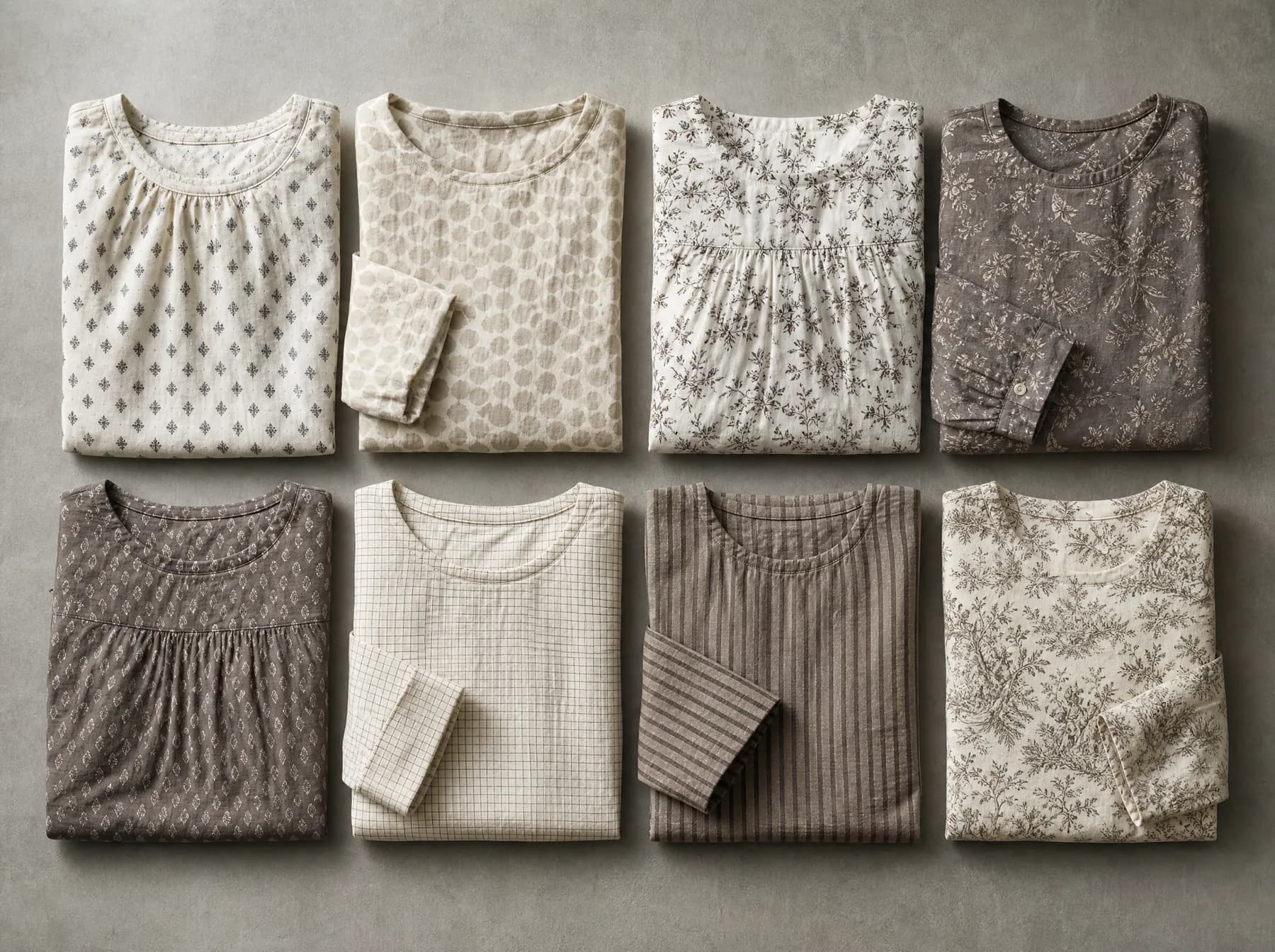
Eight folded printed garments arranged in a grid, each showing a different print surface under the same raking light.